Phrase (Basic ㊦ 67)
The space between two temporal or physical points.
Equivalent: During (the time when); while
| (i) Vて | いる間(に) | |
| 話している間(に) | While someone is talking | |
| 食べている間(に) | While someone is eating | |
| (ii) Adjective い | 間(に) | |
| 間(に)高い | While something is expensive | |
| (iii) Adjectiveな stem | な 間(に) | |
| 静かな間(に) | While something is quiet | |
| (iv) Noun | の間(に) | |
| 夏休みの間(に) | During the summer vacation |
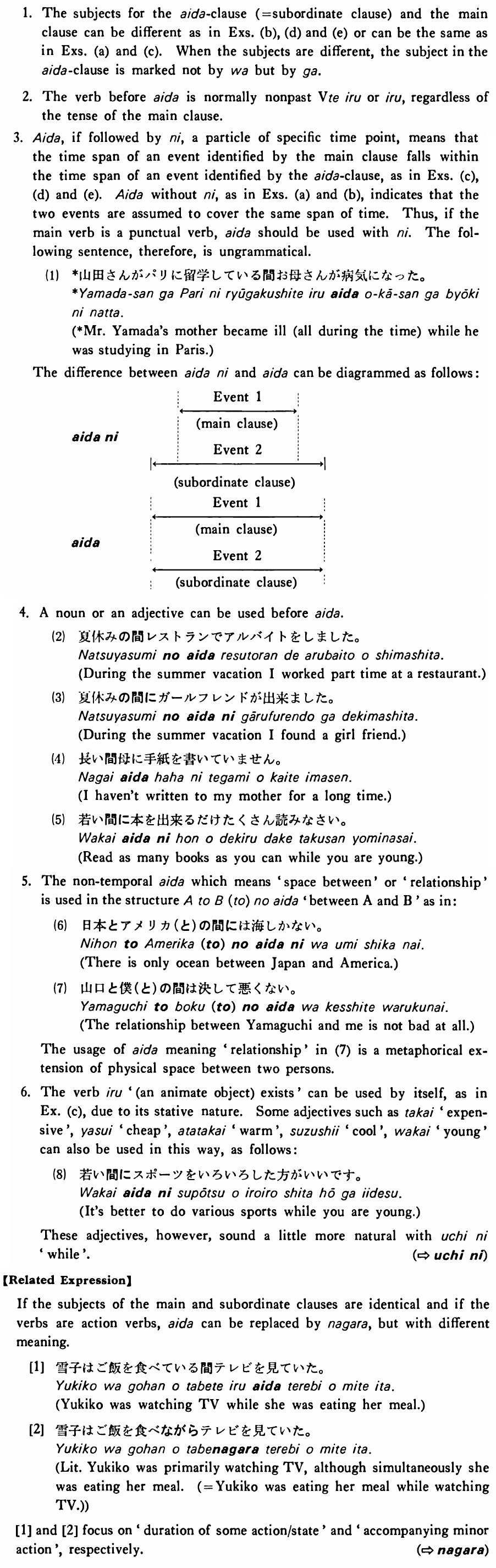
1. The subjects for the 間-clause (=subordinate clause) and the main clause can be different as in Exs. (b), (d) and (e) or can be the same as in Exs. (a) and (c). When the subjects are different, the subject in the 間-clause is marked not by は but by が.
2. The verb before 間 is normally nonpast Vている or いる regardless of the tense of the main clause.
3. 間, if followed by に, a particle of specific time point, means that the time span of an event identified by the main clause falls within the time span of an event identified by the 間-clause, as in Exs. (c) and (e). 間 without に, as in Exs. (a) and (b), indicates that the two events are assumed to cover the same span of time. Thus, if the main verb is a punctual verb, 間 should be used with に. The following sentence, therefore, is ungrammatical.
The difference between 間に and 間 can be diagrammed as follows [see bottom of Notes].
4. A noun or an adjective can be used before 間.
5. The non-temporal 間 which means 'space between' or 'relationship' is used in the structure A と B (と) の間 'between A and B' as in:
The usage of 間 meaning 'relationship' in (7) is a metaphorical extension of physical space between two persons.
6. The verb いる '(an animate object) exists' can be used by itself, as in Ex. (c), due to its stative nature. Some adjectives such as 高い 'expensive', 安い 'cheap', 暖かい 'warm', 涼しい 'cool', 若い 'young' can also be used in this way, as follows:
These adjectives, however, sound a little more natural with うちに 'while '.
If the subjects of the main and subordinate clauses are identical and if the verbs are action verbs, 間 can be replaced by ながら but with different meaning.
[1]and [2] focus on 'duration of some action/state' and 'accompanying minor action', respectively.
[Table from (1)]
間に | -------Event 1------- (main clause) Event 2 | |
| ----------------------------------------- (subordinate clause) | ||
間 | (main clause) Event 2 | |
| ----------------------------------------- (subordinate clause) | ||